Wahl

Wahl Clipper Corporation

Supplier Document Center

← Supplier Portal Packaging Spec WPKG-PRINT-001
Sourcing — Quality Specification

Packaging & Printed Material Specification

Quality inspection standards, defect classification, dimensional tolerances, and material requirements for all Wahl Clipper Corporation packaging components and systems.

Document No.WPKG-PRINT-001
Revision06
StatusDraft — Under Review
SupersedesRev05
OwnerSourcing — C. Kuntzi
Effective DatePending Release
Doc: WPKG-PRINT-001 Rev: 06 Draft Applies To: All packaging suppliers AQL: 0.65 all classes
1.0Scope

This specification defines the inspection, print quality, and material requirements for all printed packaging and packaging components supplied to Wahl Clipper Corporation. It applies to all suppliers producing or printing any Wahl packaging component and is incorporated by reference into the Wahl Supplier Quality Agreement.

SectionCategory
2.0Inspection Methods & Conditions
3.0Sampling Procedures
4.0Defect Classification
5.0POS Box, Sleeve & Insert (Paper / SBS / CRB)
6.0POS Box, Sleeve & Insert (Plastic / PET)
7.0Master Carton & Insert
8.0Labels
9.0Documentation / IFU
10.0Pulp Trays & Lids
11.0Plastic Thermoformed Tray / Lid
12.0Palletizing
13.0Molded Fiber — Dry Press & Wet Press
14.0Fabric Pouches with Zippers
15.0EVA Cases
16.0Delivery & Transit Packaging Protection
AppendixIllustrations & Reference
Sustainability Preference — Paper-Based Materials
Wahl Clipper encourages the use of sustainably sourced fiber for all paper-based packaging components. Suppliers are encouraged to source from certified forests or recycled content and maintain chain-of-custody certification. This is not a contractual requirement. Recognized programs include:
  • FSC — Forest Stewardship Council (fsc.org)
  • PEFC — Programme for the Endorsement of Forest Certification (pefc.org)
  • SFI — Sustainable Forestry Initiative (forests.org)
  • ATFS — American Tree Farm System or equivalent regional programs
Suppliers with certified materials are encouraged to note the applicable certification and chain-of-custody code on submitted material data sheets and PO confirmations.
2.0Inspection Methods & Conditions
2.1 Inspection Distance

18 inches (457 mm) from eye to unit.

2.2 Inspection Duration
Part DescriptionDuration
Label3–5 seconds per part
Tray / Lid5–7 seconds per part
Molded Fiber Component5–7 seconds per part
Fabric Pouch8–10 seconds per part
EVA Case8–10 seconds per part
Documentation / IFU3–5 seconds per sheet
POS Box / Sleeve / Insert8–10 seconds per part
Master Carton / Insert8–10 seconds per part
2.3 Inspection Conditions

Rotate 30° from the horizontal plane. Rotate 30° right and left during inspection.

2.4 Light Source

Normal light condition: 80–120 ft-candles, white fluorescent lamp.

3.0Sampling Procedures
AttributeRequirement
StandardISO 2859-1 (ANSI/ASQ Z1.4)
Inspection LevelLevel II — Normal Inspection
Sampling TypeSingle Sample Inspection
AQL — Critical0.65
AQL — Major0.65
AQL — Minor0.65
A single AQL of 0.65 applies uniformly across all defect classes per this specification. This is a stricter standard than typical industry practice and reflects Wahl's quality expectations for all supplier tiers.
4.0Defect Classification
ClassDefinition
CriticalA defect that impedes the usage of the product. Cause for rejection.
MajorA defect that causes substantial degradation to the usability of the product for its intended application.
MinorA defect that is not a substantial degradation for the product application, or a deviation from existing standards irrelevant to the effective use of the product.
5.0POS Box, Sleeve & Insert (Paper / SBS / CRB)
5.1 Panel Classification
PanelDefinition
Panel AMajor/primary panels — panels containing legal copy or critical design elements
Panel BSecondary panels — sides, interior
Panel CHidden panels — dust flaps
5.2 Dimensional Tolerances

All dimensions refer to internal finished dimensions of the erected carton unless otherwise stated on the item drawing.

DimensionTolerance
Length / Width / Depth±1.0 mm
Caliper (board thickness)±0.05 mm (per TAPPI T 411)
Bleed registration to artwork spec±3.0 mm
Bleed from score line (top/bottom)±5.0 mm
Bleed from score line (sides)±8.0 mm
Sleeve misalignment±1.0 mm max
Embossing / UV / foil registration±1.6 mm (1/16")
Tolerances listed are maximums. Item-level drawings supersede where tighter tolerances are specified.
Critical5.3 Critical Defects
  • Dimensions deviate sufficiently to impede usage of the product
  • Smearing, bleeding, or hazing sufficient to impede usage of the product
  • Cracking that impedes structural functionality of the package
  • Sleeve misalignment sufficient to impede usage of the product
  • Printed text illegible
  • Bleed registration deviates sufficiently to impede usage
  • Insufficient glue that impedes usage of the product
Major5.4 Major Defects
  • Dimensions deviate from dimensional specification tolerances
  • Discoloration — color density outside approved tolerances
  • Specks, hickies, bubbles, blemishes: >2 mm diameter on Panel A; more than 3 defects no closer than 30 mm apart on Panel A
  • Scratches: >5 mm × 0.5 mm on Panel A; more than 3 defects no closer than 30 mm apart
  • Creases >5 mm on Panel A
  • Cracking of paper on flat panel surface (not at score line) on Panel A and B
  • Cracking at score/fold line: >0.5 mm thickness — max score/fold length; 0.6–1 mm — max ½ score/fold length; >1 mm — not allowed
  • Corner split >5 mm
  • Excessive glue or foreign materials on Panel A and B
  • Paper peeling or separation at scores
  • Dents and deformation >5 mm on Panel A and B
  • Water mark >5 mm on Panel A
  • Pressure mark >10 mm on Panel A and B
  • Sleeve misalignment >1 mm
  • Bleed registration: >±3 mm from artwork; >±5 mm top/bottom or >±8 mm side from score lines
  • Missing ink on printed side of Panel A and B
  • Barcode will not scan or returns incorrect data
  • Embossing, UV coating, or foil stamping registration >1.6 mm (1/16")
  • Foil stamping — missing, broken, or ragged edges >1.5 mm
  • Tears, holes, and contamination (oil/grease/moisture)
  • Scuffing resulting in paper show-through or white mark >5 mm × 0.5 mm on Panel A and B
Minor5.5 Minor Defects
  • Specks, bubbles, hickies, blemishes: >2 mm on Panel B (max 3, ≥30 mm apart); <2 mm on Panel A
  • Scratches: >5 mm × 0.5 mm on Panel B (max 3); <5 mm × 0.5 mm on Panel A
  • Creases >5 mm on Panel B
  • Deep label artwork creases >½ length on Panel A and B
  • Blistering of the label
  • Water mark >5 mm on Panel B
  • Pressure marks >5 mm but ≤10 mm on Panel A and B
  • Missing ink on printed side of Panel C, or ink on unprinted side
  • Notching >1.5 mm on Panel A and B (see Illustration 6)
6.0POS Box, Sleeve & Insert (Plastic / PET)

Panel classification same as Section 5.1 — Panel A (primary), Panel B (secondary), Panel C (hidden).

6.2 Dimensional Tolerances
DimensionTolerance
Length / Width / Depth±1.0 mm
Sleeve misalignment±1.0 mm max
Bleed registration to artwork spec±3.0 mm
Bleed from score line (top/bottom)±5.0 mm
Bleed from score line (sides)±8.0 mm
Embossing / UV / foil registration±1.6 mm (1/16")
Tolerances listed are maximums. Item-level drawings supersede where tighter tolerances are specified.
Critical6.3 Critical Defects
  • Dimensions deviate sufficiently to impede usage
  • Smearing, bleeding, or hazing sufficient to impede usage
  • Cracking that impedes structural functionality
  • Sleeve misalignment sufficient to impede usage
  • Printed text illegible
  • Bleed registration deviates sufficiently to impede usage
  • Insufficient glue that impedes usage
  • Tears, holes, and contamination (oil/grease/moisture)
Major6.4 Major Defects
  • Dimensions deviate from specification tolerances
  • Discoloration — color density outside approved tolerances
  • Specks, hickies >2 mm on Panel A; more than 3 no closer than 30 mm apart
  • Scratches >5 mm × 0.5 mm on Panel A (max 3 no closer than 30 mm apart)
  • Creases >5 mm on Panel A
  • Cracking: none on Panel A; up to 5 mm on Panel B; up to 10 mm on folds/Panel C
  • Corner split >5 mm
  • Excessive glue or foreign materials on Panel A and B
  • Dents and deformation >5 mm on Panel B
  • Water mark >5 mm on Panel A; Pressure mark >10 mm on Panel A and B
  • Sleeve misalignment >1 mm
  • Bleed registration: >±3 mm from artwork; >±5 mm top/bottom or >±8 mm sides
  • Missing ink on Panel A and B; barcode will not scan
  • Embossing/UV/foil registration >1.6 mm; foil edges ragged >1.5 mm
  • Scuffing on Panel A and B >5 mm × 0.5 mm
Minor6.5 Minor Defects
  • Specks, bubbles >2 mm on Panel B (max 3, ≥30 mm apart); <2 mm on Panel A
  • Scratches >5 mm × 0.5 mm on Panel B; <5 mm × 0.5 mm on Panel A
  • Creases >5 mm on Panel B
7.0Master Carton & Insert
7.1 Dimensional Tolerances
DimensionTolerance
Internal L / W / H±2.0 mm
Wall caliper (corrugated)Per supplier board grade; ECT ≥ 32 lb/in (5,600 N/m)
Gap width at score line≤ 9.5 mm (5/16") max
Fishtail gap width from score±3.2 mm (1/8") max
Horizontal slot movement±3.2 mm (1/8") max
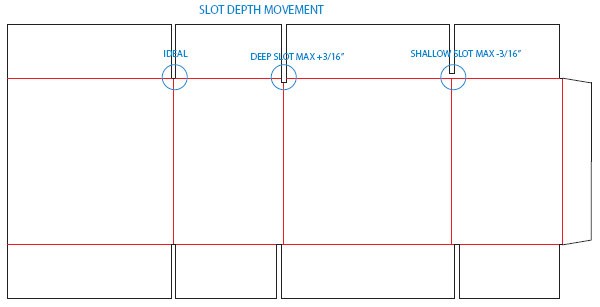
Slot depth movement±4.8 mm (3/16") max
Insert flatness deviation≤ 5 mm across full face
Internal dimensions govern for product fit. Supplier to provide board test records confirming ECT rating with each production lot.
Critical7.2 Critical Defects
  • Dimensions deviate sufficiently to impede usage of the product
  • Cracks that impede structural functionality
  • Insufficient or excessive glue impacting box use
  • Shipping carton does not meet or exceed ECT rating of 32 lb/in (5,600 N/m)
  • Overpack BMC does not match raw material provided (where BMC is specified in the art plan)
Major7.3 Major Defects
  • Dimensions deviate from specification tolerances
  • Cracking showing inside liner
  • Exposed glue when box is folded
  • Print text illegible; dents >5 mm; corner splits >5 mm; foreign materials >5 mm
  • Gap width >9.5 mm (5/16") from score line
  • Fishtailing: gap width difference >±3.2 mm (1/8"); gap >8.7 mm
  • Horizontal slot movement >±3.2 mm (1/8"); slot depth movement >±4.8 mm (3/16")
  • Paper peeling and separation at scores
  • Supplier to maintain board test records for 1 year from supply date
Minor7.4 Minor Defects
  • Dents and deformation <5 mm
  • Tears, holes, and contamination (oil/grease/moisture)
  • Overpack art does not conform with print art plan
8.0Labels
8.1 Dimensional Tolerances

Tolerances apply to finished, die-cut labels. Reference: TLMI recommended manufacturing standards.

DimensionTolerance
Finished label length / width±0.8 mm
Die-cut to print registration±0.5 mm
Color-to-color registration±0.25 mm
Adhesive / zone coat position±1.0 mm
Label gap on liner (auto-apply)3 mm min
Roll core inside diameter76.2 mm (3") nominal
Max roll outside diameterPer purchase order
For labels applied by automated equipment, tolerance conformance must be validated against the application machine's specification sheet prior to production approval.
Critical8.2 Critical Defects
  • Dimensions deviate sufficiently to impede usage
  • Smearing, bleeding, or hazing sufficient to impede usability
  • Printed text and information illegible
  • Excessive glue that impedes usability
  • Tears, holes, and contamination
  • Use of adhesives that do not meet specification for tack or release
Major8.3 Major Defects
  • Dimensions deviate from specification tolerances
  • Misalignment of text deviating from specification tolerances
  • Discoloration — color density deviations from CMYK/Pantone specification
  • Damage and label tearing
  • Incorrect label orientation in the roll
Minor8.4 Minor Defects
  • Glue or foreign material visible on the surface
  • Specks, bubbles, hickies, and blemishes visible on the surface
9.0Documentation / IFU
9.1 Dimensional Tolerances
DimensionTolerance
Finished trim size (L × W)±1.5 mm
Page-to-page registration (folded)±1.0 mm
Fold position from edge±1.5 mm
Caliper / paper stockPer specified GSM ±5% (TAPPI T 411)
Color density variation≤ 10% from approved Pantone reference
Critical9.2 Critical Defects
  • Dimensions deviate sufficiently to impede usage
  • Printing errors that impede usage
  • Misalignment of pages sufficient to impede usage
  • Incorrect formatting or sequence deviates from specification
  • Printed text illegible
  • Excessive or insufficient glue impacting usage of the manual
  • Paper stock deviates from specification
  • Tears, holes, and contamination
Major9.3 Major Defects
  • Dimensions deviate from specification tolerances
  • Color density variation >10% of Pantone color
  • Crease on visible area; paper separation at scores; paper peeling or tearing
  • Corner split >3 mm
  • Glue or foreign material on visible surface
  • Barcode will not scan or returns incorrect data
  • Scratch or scuff >5 mm × 0.5 mm; more than 3 defects <30 mm apart
  • Hickie, speck, or blemish >1 mm; more than 3 defects <30 mm apart
Minor9.4 Minor Defects
  • Blistering of cover and other visible areas
  • Scratch or scuff <5 mm × 0.5 mm
  • Hickies, specks, and blemishes <1 mm
10.0Pulp Trays & Lids
10.1 Dimensional Tolerances
DimensionTolerance
Overall L / W / H±1.5 mm
Pocket / cavity depth±1.5 mm
Wall thickness±0.5 mm of nominal
Flatness / warp across full face≤ 3.0 mm deviation from flat reference
Lid fit clearance0 – 1.5 mm gap when nested
Critical10.2 Critical Defects
  • Dimensions deviate sufficiently to impede usage
  • Splits and cracks that impede structural functionality
  • Printed text and logo illegible
Major10.3 Major Defects
  • Dimensions deviate from specification tolerances
  • Discoloration — color density outside approved tolerances
  • Specks/stains: >1 mm on Wahl text (max 3, ≥20 mm apart); >2 mm on logo area (max 3, ≥20 mm apart); >5 mm outside logo area (max 3, ≥10 mm apart)
  • Scratches >5 mm; creases >30 mm on non-text area; cracking outside pocket rib area
  • Foreign material on front side; paper peeling and separation; tears, holes, contamination
Minor10.4 Minor Defects
  • Intense blemishes
  • Deep crease on front side of tray
11.0Plastic Thermoformed Tray / Lid
11.1 Dimensional Tolerances
DimensionTolerance
Overall L / W / H±0.5 mm
Pocket / cavity depth±0.5 mm
Wall thickness±0.2 mm of nominal
Flatness / warp across full face≤ 1.0 mm deviation from flat reference
Lid fit clearance0 – 0.8 mm gap when nested
Haze / clarityPer approved limit sample or spectrophotometer reference
Critical11.2 Critical Defects
  • Dimensions deviate sufficiently to impede usage
  • Splits and cracks that impede structural functionality
  • Printed text and logo illegible
  • Material resin marks not matching material used in production (excludes #7 Other resin)
Major11.3 Major Defects
  • Dimensions deviate from specification tolerances
  • Discoloration; haze and clarity outside approved tolerance
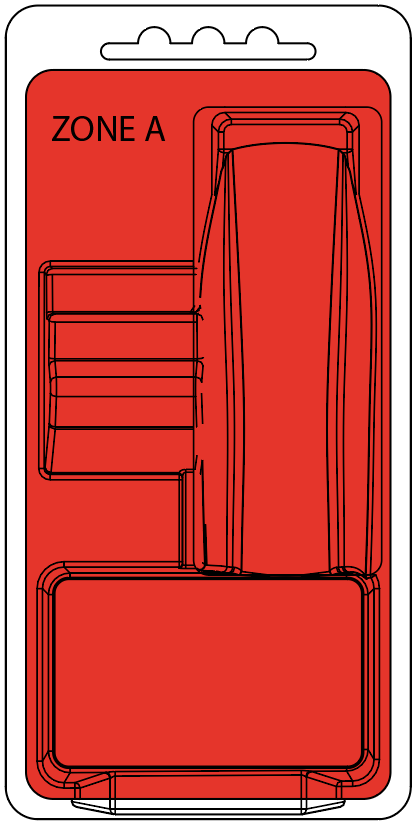
  • Foreign material or damage in Zone A (see Illustration 5)
  • Scratches >5 mm; creases >30 mm on non-text area; cracks, tears, holes, contamination
  • More than 3 craters or gels >1 mm² in Zone A; more than 3 carbon specks >0.3 mm² <25 mm apart in Zone A
  • Nick or notch >1 mm; recycle symbol formed into plastic
Minor11.4 Minor Defects
  • Intense blemishes
  • Defects in Zone B and Zone C
12.0Palletizing
12.1 Dimensional Tolerances
DimensionTolerance
Pallet footprint (L × W)Per pallet specification (WPQD_PALLET_REV01)
Load overhang from pallet edge≤ 25 mm any side
Max stacked load heightPer purchase order / load plan
Top board gap width≤ 9.5 mm between boards
Exposed splinter length≤ 76 mm (critical threshold)
Critical12.2 Critical Defects
  • Pallet dimensions beyond allowable tolerance
  • Pallets with broken, split wood and/or exposed nails
  • Missing or broken boards
  • Exposed splinters >76 mm
  • Partial footings (¼ of stringer board missing at nail)
  • Taper breaks with depth >25 mm along 250 mm length
  • Cracks on top or bottom boards >3 mm wide × 380 mm long
  • Double stringers, patched boards, or metal repair plates
  • Grade C Tier Pallet (see WPQD_PALLET_REV01 §1.4.3)
Major12.3 Major Defects
  • Pallet not meeting minimum Grade B tier standard
  • Load not secured or improperly stretch-wrapped
  • Stacking pattern does not match approved load plan
Minor12.4 Minor Defects
  • Excessive discoloration and staining; noticeable odor
  • Tapered breaks <25 mm along 250 mm length
  • Non-continuous weathering cracks on top surface
  • Sink holes or knit lines >6 mm in plastic pallets
13.0Molded Fiber — Dry Press & Wet Press
13.1 Process Overview
AttributeDry Press (Traditional)Wet Press (Thermoformed)
Primary UseInner cushioning, master carton insertsRetail-facing trays, premium inserts
Surface FinishRough/fibrous non-mold side; smooth mold sideSmooth, high-definition both sides
Wall Thickness3.0 – 6.0 mm typical0.8 – 2.0 mm typical
Dimensional Tolerance±1.0 mm±0.5 mm
Critical13.2 Critical Defects (Both Processes)
  • Dimensions deviate sufficiently to prevent proper fit or assembly
  • Splits, cracks, or fractures that impede structural functionality or product retention
  • Sharp edges or protruding fibers capable of causing injury
  • Mold contamination — visible mildew, mold growth, or biological matter
  • Foreign matter embedded in the fiber structure
  • Moisture causes structural softening or collapse under normal handling
  • Printed text, logo, or regulatory markings illegible or missing where specified
  • Dimensional deviation causing product movement >3 mm inside final package assembly
Major13.3 Major Defects — Dry Press

Dimensional

  • Wall thickness outside ±1.5 mm of nominal
  • Overall part dimensions outside ±1.0 mm
  • Warping >3 mm from flat reference across any 100 mm span
  • Pocket or cavity depth outside ±1.5 mm

Structural

  • Delamination or fiber separation on mold-side >5 mm
  • Cracks or splits >10 mm on any load-bearing surface
  • Visible voids >10 mm² reducing wall section by >25%
  • Stacking or compression failure under standard pallet load

Surface & Appearance

  • Stains, discoloration >10 mm on mold-side surface
  • Fiber pull or de-bonding on mold-side >15 mm²
  • Screen marks >20 mm on mold-side surface
  • Flash or fiber overflow at edges >3 mm beyond trim line

Moisture

  • Moisture content >12% by weight at receipt (TAPPI T 412)
  • Visible water damage, staining, or softening
Major13.4 Major Defects — Wet Press

Dimensional

  • Wall thickness outside ±0.5 mm; overall dimensions outside ±0.5 mm
  • Warping >1.5 mm from flat reference across any 100 mm span
  • Pocket or cavity depth outside ±0.5 mm

Structural

  • Delamination or fiber separation on either surface >3 mm
  • Cracks or splits >5 mm on any surface
  • Visible voids >5 mm² reducing wall section by >20%
  • Any pin holes or perforations visible on mold-side surface

Surface & Appearance

  • Stains or contamination >5 mm on either surface
  • Surface blemishes >2 mm diameter on visible side: more than 3 no closer than 30 mm apart
  • Color density variation outside approved specification on printed areas
  • Hazing or surface dulling on gloss/semi-gloss areas
  • Embossed text: registration >1.0 mm from specified position
  • Flash at edges >1.5 mm beyond trim line

Moisture

  • Moisture content >10% by weight at receipt (TAPPI T 412)
  • Visible water damage, warping, or surface softening
Minor13.5 Minor Defects (Both Processes)
  • Stains or blemishes within acceptable size limits on non-visible surfaces
  • Slight color variation within approved range on non-printed areas
  • Minor surface roughness on non-mold side of dry press components
  • Flash or fiber overflow: ≤1.5 mm (wet press) or ≤3 mm (dry press)
  • Minor fiber fuzz that does not affect product fit or structural integrity
13.6 Material & Certification Requirements
RequirementSpecification
Fiber sourceVirgin or recycled fiber; PCW content as specified on PO
Prohibited substancesREACH SVHC compliant; no PFAS/PFOA
Moisture at receipt≤ 12% (dry press) / ≤ 10% (wet press) — TAPPI T 412
Density range0.8 – 1.2 g/cm³
Waterproofing agentsAKD or equivalent; food-safe grade; declared on MSDS
Records retention2 years from ship date
13.7 Transit & Functional Testing
Test TypeReference Standard
Drop testASTM D5276 or ISTA 1A/3A
Vibration testASTM D999 or ISTA 1A/3A
Environmental conditioningASTM D4332 (23°C / 50% RH, 24 hr minimum)
Compression / stackingASTM D642
Supplier is responsible for providing test reports with first article submission. Wahl reserves the right to require re-validation upon any change in material, tooling, or process.
14.0Fabric Pouches with Zippers
14.1 Dimensional Tolerances

All dimensions refer to the finished, closed pouch unless otherwise stated on the item specification.

DimensionTolerance
Overall length / width / height±3.0 mm
Seam allowance width±1.5 mm of specified
Zipper tape position from edge±2.0 mm
Zipper pull stop position from end±3.0 mm
Stitch density8–12 SPI; ±1 SPI of specified
14.2 Logo, Mark & Decoration Tolerances
Decoration TypePlacement ToleranceNotes
Embroidered logo±3.0 mm from center pointAll axes
Woven label (sewn in)±3.0 mm from specified positionAll four sides flat and tacked
Heat transfer / screen print±3.0 mm from center pointAll axes
Debossed / embossed mark±2.0 mm from specified position
Patch (sewn on)±3.0 mm; all edges stitchedNo lifting edges
Embroidery AttributeRequirement
Thread color matchWithin ±1 Pantone step of approved specification
Fill densityNo visible gaps in fill area >1.0 mm
UnderlayRequired beneath all embroidery; no fabric distortion around logo
Stitch directionPer approved artwork file
Jump stitches on visible surfaceNot allowed — must be trimmed flush
Loose thread tails on embroidery≤ 3.0 mm; trimmed flush preferred
14.3 Sewing & Seam Quality
14.3.1 Loose Thread Allowances
LocationLoose Thread Limit
External — primary (front face)None allowed >3.0 mm; must be trimmed ≤3.0 mm
External — secondary (back, sides)≤ 5.0 mm; trimmed preferred
Internal lining — visible areas≤ 5.0 mm
Internal lining — non-visible / hidden≤ 10.0 mm acceptable
At zipper attachment seamNone allowed — all tails trimmed flush
At logo / label attachment seamNone allowed — all tails trimmed flush
Thread tails must be cut cleanly, not burned. Burned or melted thread ends on visible surfaces are a Major defect.
14.3.2 Sewing Gap Standards

A sewing gap is any break, skip, or separation in a seam where thread is absent or seam integrity is compromised.

Seam ZoneAllowable Gap
Structural seam (load-bearing, perimeter)Zero gaps allowed
Zipper attachment seamZero gaps allowed
Logo / label attachment — all four sidesZero gaps allowed
Decorative top-stitch (non-structural)≤ 1 skip per 100 mm; max 1 occurrence per seam
Interior lining seam (non-structural)≤ 2.0 mm gap; max 1 occurrence per seam
Any sewing gap at a stress point (corner, zipper end, strap anchor) is a Critical defect regardless of gap size.
Critical14.4 Critical Defects
  • Sharp or broken zipper teeth, slider fragments, or metal hardware capable of causing consumer injury
  • Needle, pin, wire, or foreign object found inside or embedded in the pouch
  • Toxic or chemically hazardous odor from material or dye
  • Open or broken structural seam allowing contents to escape
  • Zipper completely non-functional — will not open or close
  • Fabric hole or tear compromising the pouch's ability to retain contents
  • Sewing gap at any stress point (corner, zipper end, strap anchor)
  • Labeling or compliance markings missing where required by applicable regulation
  • Fabric or dye fails restricted substance requirements (REACH SVHC, CPSIA, Prop 65)
Major14.5 Major Defects

Zipper & Hardware

  • Zipper jams, skips teeth, or requires excessive force; halves don't meet flush (gap >2.0 mm)
  • Zipper tape not fully sewn — open attachment >5.0 mm from end; end stop missing or loose
  • Metal hardware loose, uneven, or non-functional; zipper pull type/color not per specification

Sewing & Construction

  • Skipped stitches — more than 1 per 50 mm; seam alignment deviation >3.0 mm
  • Seam allowance <5.0 mm at any structural seam
  • Open or unfinished seam edge on any external or visible interior surface
  • Corner reinforcement missing at stress points; burned or melted thread end on visible surface
  • Sewing gap exceeding zone allowances in §14.3.2

Logos, Marks & Decoration

  • Logo/mark placement outside ±3.0 mm of specified position
  • Embroidery fill with visible gap >1.0 mm; jump stitches visible on external surface
  • Loose thread tail >3.0 mm on primary or >5.0 mm on secondary surface
  • Woven label with unstitched edges or lifting corners
  • Heat transfer/print with lifting, cracking, or feathered edge >1.0 mm; logo color outside ±1 Pantone step
  • Fabric distortion or puckering around embroidery >3.0 mm from logo boundary

Material & Surface

  • Fabric color/finish doesn't match approved sample; dye bleeding or migration on visible surface
  • Lining detached or bubbling >20 mm²; fabric pilling >10 mm on primary face
  • Water resistance failure on coated fabrics — ingress within 1 minute
Minor14.6 Minor Defects
  • Loose thread ends ≤5.0 mm on secondary/interior surfaces (within zone limits of §14.3.1)
  • Slight uneven stitch spacing within ±1 SPI of specification
  • Minor color shading between components — within grey scale rating 4 (ISO 105-A02)
  • Surface lint, dust, or minor soiling removable without damage
  • Small fabric irregularities (neps, slubs) <3.0 mm on secondary surfaces
14.7 Material & Certification Requirements
RequirementSpecification
Fabric typePer item specification (polyester, nylon, canvas, etc.)
Zipper typePer item specification; YKK or approved equivalent
ThreadPolyester core-spun; color matched to specification
Restricted substancesREACH SVHC compliant; CPSIA compliant (if applicable)
ColorfastnessMinimum grey scale rating 4 (ISO 105-A02)
Seam strength≥ 45 N at all structural seams (ASTM D1683 or ISO 13935-1)
Zipper durability≥ 500 open/close cycles without failure
Records retention2 years from ship date
15.0EVA Cases
15.1 Dimensional Tolerances

All dimensions refer to the finished, closed case unless otherwise stated on the item specification.

DimensionTolerance
Overall L / W / H (external)±1.5 mm
Interior cavity L / W / H±1.0 mm
EVA shell wall thickness±0.5 mm of nominal
Foam insert thickness±1.0 mm of nominal
Zipper tape position from edge±2.0 mm
Case closed gap (halves meeting)≤ 1.5 mm any point along perimeter
15.2 Logo, Mark & Decoration Tolerances
Decoration TypePlacement ToleranceNotes
Debossed / embossed mark on EVA±2.0 mm from specified positionDepth consistent across full mark
Screen print / pad print on EVA±2.0 mm from specified centerAll axes
Embroidered logo (fabric-covered)±3.0 mm from specified centerAll axes
Woven label (sewn in)±3.0 mm from specified positionAll four sides flat and tacked
Heat transfer on fabric shell±3.0 mm from specified centerAll axes
Patch (sewn on)±3.0 mm; all edges stitchedNo lifting edges
Deboss / Emboss AttributeRequirement
Depth consistencyUniform across full mark — variation ≤ 0.3 mm
Edge definitionClean — no tearing, crumbling, or feathering of EVA at mark edge
Placement±2.0 mm from specified center in all axes
15.3 Sewing & Seam Quality (Fabric-Covered EVA)

See Section 14.3 for embroidery standards. Loose thread and sewing gap standards below apply independently to EVA cases.

LocationLoose Thread Limit
External fabric — primary faceNone >3.0 mm; must be trimmed
External fabric — secondary (sides, back)≤ 5.0 mm; trimmed preferred
At zipper attachment seamNone allowed — all tails trimmed flush
At logo / label attachment seamNone allowed — all tails trimmed flush
Interior lining or non-visible seams≤ 10.0 mm acceptable
Seam ZoneAllowable Gap
Structural seam (perimeter, load-bearing)Zero gaps allowed
Zipper attachment seamZero gaps allowed
Logo / label attachment — all four sidesZero gaps allowed
Decorative top-stitch (non-structural)≤ 1 skip per 100 mm; max 1 occurrence per seam
Interior lining seam (non-structural)≤ 2.0 mm gap; max 1 occurrence per seam
Any sewing gap at a stress point (corner, zipper end, hinge area) is a Critical defect regardless of gap size.
Critical15.4 Critical Defects
  • Sharp edges, cracks, or fractures on EVA shell capable of causing consumer injury
  • Needle or foreign object found inside the case
  • Zipper completely non-functional — will not open or close
  • Interior cavity prevents product from fitting or being removed
  • Shell deformation or compression set prevents case from closing
  • Toxic or chemically hazardous odor from EVA, foam, or adhesive
  • Sewing gap at any stress point (corner, zipper end, hinge)
  • Structural seam or hinge failure causing case to separate into halves
  • Material fails applicable restricted substance requirements (REACH SVHC, CPSIA, Prop 65)
Major15.5 Major Defects

Dimensional & Fit

  • External dimensions outside ±1.5 mm; interior cavity outside ±1.0 mm
  • Shell wall thickness outside ±0.5 mm; case halves don't align flush (gap >1.5 mm)
  • Foam outside ±1.0 mm or doesn't return to shape within 60 seconds after compression

Zipper & Hardware

  • Zipper jams, skips teeth, or requires excessive force; halves don't seat correctly
  • Zipper tape not fully bonded or sewn — separation >5.0 mm from end
  • Zipper end stop missing or loose; pull tab missing, mismatched, or non-functional

Shell & Surface

  • EVA shell warping — deviation >3.0 mm from flat reference across any 50 mm span
  • Cracks, chips, or splits on EVA shell exterior
  • Laminated fabric bubbling, delaminating, or peeling >10 mm²
  • Discoloration, staining, or dye migration on any external surface
  • Glue squeeze-out visible on exterior >5.0 mm; uneven lamination >20 mm on primary face

Logos, Marks & Decoration

  • Logo/mark placement outside tolerance defined in §15.2
  • Deboss/emboss depth inconsistency >0.3 mm; tearing or feathering of EVA at mark edge
  • Print with lifting, cracking, or feathered edge >1.0 mm
  • Jump stitches visible on external fabric; thread tail >3.0 mm on primary or >5.0 mm on secondary
  • Burned or melted thread end on visible surface; woven label with unstitched edges

Foam Interior

  • Foam dimensions outside ±1.0 mm; foam fails to retain product under 0.5 G lateral force
  • Foam tears or holes >5.0 mm; foam not bonded to shell — lifts >10.0 mm from any edge
Minor15.6 Minor Defects
  • Minor surface scuffs <5.0 mm on non-primary (bottom/back) EVA surfaces
  • Slight color variation within approved range
  • Loose thread ends within zone limits defined in §15.3
  • Minor foam surface irregularities (indentations <3.0 mm) on non-visible interior surfaces
  • Small glue residue <3.0 mm on non-visible interior surfaces
15.7 Material & Certification Requirements
RequirementSpecification
EVA shellEthylene Vinyl Acetate; hardness per item spec (Shore C or A)
Foam insertPE or EVA foam; density and hardness per item spec
Fabric coveringPer item specification; color matched to approved sample
Zipper typePer item specification; YKK or approved equivalent
Restricted substancesREACH SVHC compliant; CPSIA compliant (if applicable)
RoHS complianceRequired for all cases packaged with electronic accessories
Drop performance1.0 m drop onto concrete — 6 faces, 4 edges, 2 corners; product undamaged
Compression performance50 cycles at 500 N; product inside undamaged
Temperature rangeFunctional −20°C to +60°C; no deformation or seal failure
Records retention2 years from ship date
16.0Delivery & Transit Packaging Protection
16.1 Supplier Accountability Statement

The supplier is responsible for ensuring that all Wahl Clipper packaging components and materials arrive at the designated delivery location in the condition specified in this document. This responsibility extends beyond the quality of the article itself to include the adequacy of the delivery system — meaning the outer packaging, inner protection, moisture barriers, and any supplementary protective measures used to protect the article during transit, handling, and storage prior to receipt.

Any article damage, degradation, or contamination attributable to an inadequate or non-conforming delivery packaging system is the responsibility of the supplier and is subject to claim, return, or cost recovery per the Wahl Supplier Quality Agreement.

Damage Attribution: If water ingress, moisture damage, crushing, contamination, or other transit-related damage is found at receiving inspection, and the delivery packaging is found to be absent, insufficient, or non-conforming to this specification, the damage is presumed attributable to the supplier's delivery system unless evidence of external carrier damage is documented at the time of delivery.
16.2 General Delivery Packaging Requirements

Suppliers must design their delivery packaging system to protect articles against all foreseeable hazards including mechanical shock and vibration, compressive loading, moisture (humidity, condensation, direct water contact), temperature cycling, and contamination. The delivery packaging system must be validated prior to first production shipment. Any change to packaging material, configuration, or supplier requires re-validation.

16.3 Moisture & Hydration Protection
16.3.1 Moisture Protection by Article Type
Article CategoryMinimum Required Protection
Paper / SBS / CRB folding cartonsPoly bag liner inside master carton or moisture-resistant master carton liner
Master cartons (corrugated)Moisture-resistant box liner for ocean / high-humidity shipments
Labels (roll stock)Individual roll poly bags sealed; master carton lined
Documentation / IFUPoly bag per bundle; master carton lined for ocean shipments
Molded fiber — dry pressPoly bag per tray stack or master carton liner; desiccant required
Molded fiber — wet pressIndividual poly bag per unit or tray-level poly sleeve; desiccant required
Pulp trays & lidsPoly bag per stack; desiccant required
Fabric pouchesIndividual poly bag per unit or sealed poly bag per pack quantity
EVA casesIndividual poly bag per unit
Plastic thermoformed traysIndividual poly bag per unit or tray-stack poly bag
16.3.2 Desiccant Requirements

Desiccant is required for fabric pouches (sewn construction) and EVA cases where absorbed moisture during transit or storage creates a critical risk of mold, mildew, or biological growth on fabric, foam, or textile materials. Desiccant is not a general requirement for paper-based or corrugated packaging unless specifically called out on the applicable purchase order or drawing.

RequirementSpecification
Desiccant typeSilica gel (ISO 9001 grade) or clay desiccant; molecular sieve acceptable
Unit sizePer supplier calculation based on carton volume and transit duration; minimum 1 unit per master carton
Packaging formTyvek sachet or non-woven sachet — no loose granule packets
PlacementInside sealed poly liner, adjacent to articles — not in direct contact with printed surfaces
IndicatorHumidity indicator card (HIC) required inside each master carton for ocean shipments — single-use, 3-spot minimum
ProhibitedDo not use calcium chloride desiccants — liquid release risk
16.3.3 Box / Carton Liners
Liner TypeMinimum Specification
Poly bag liner (master carton)LDPE or LLDPE; minimum 2.0 mil (51 µm); sealed or folded closed after loading
Kraft paper linerNot acceptable as sole moisture protection; acceptable as void-fill supplement only
All poly bags and liners must be sealed — twist-tie closure is not acceptable as sole seal method. Heat seal preferred; fold-and-tape acceptable for master carton liners. Seal integrity: no open seams, pinholes, or tears at time of pack.
16.4 Inner Pack & Cushioning

Articles must be packed to prevent relative movement that could cause abrasion, scuffing, or crushing. Void fill required when articles occupy less than 85% of master carton volume. Acceptable: paper cushion, molded fiber pads, air pillows (LDPE), EPE foam sheets. Not acceptable: loose packing peanuts (polystyrene or starch) unless enclosed in a contained bag. Stacking orientation must be marked (THIS SIDE UP / ↑) when article orientation is critical. Maximum stack height / weight must not exceed the carton's stated ECT or BCT rating.

Critical16.5.1 Critical — Delivery Packaging Failures
  • Master carton crushed, punctured, or collapsed — articles inside damaged or may be damaged
  • Evidence of water ingress (wet liner, wet articles, watermarks on inner surfaces)
  • Poly liner absent where required by §16.3.1
  • Desiccant absent from fabric pouch or EVA case shipments where required by §16.3.2
  • Humidity indicator card (HIC) shows red / triggered condition at receipt
  • Visible mold, mildew, or biological growth on any article or inner packaging surface
  • Contamination (oil, chemical, pest evidence) inside the master carton
Major16.5.2 Major — Delivery Packaging Non-Conformances
  • Poly liner present but not sealed — folded open or torn at seal
  • Desiccant present but incorrect type, size, or placement
  • Humidity indicator card missing from ocean shipments
  • Insufficient void fill — articles freely shifting >25 mm within carton
  • Stacking orientation markings absent when required
  • Individual article poly bags missing, unsealed, or torn prior to receipt
  • Master carton shows significant moisture damage without evidence of article impact
Minor16.5.3 Minor — Delivery Packaging Observations
  • HIC present but partially triggered (1 of 3 spots) with articles dry and undamaged
  • Void fill present but insufficient to prevent minor shifting (<25 mm)
  • Poly bag present but not heat-sealed — fold-tape closure intact and effective
  • Minor external carton scuffing with no impact on articles inside
16.6 Documentation & Traceability
RequirementDetail
Packing listRequired with every shipment; must reference PO number, item numbers, quantities, and lot/batch numbers
Moisture protection statementSupplier to confirm method used on packing list or COA for ocean shipments
Desiccant lot traceabilitySupplier name and lot number to be recorded; available upon request
Carrier damage documentationNoted on delivery receipt at time of delivery; photographed before unloading
Supplier response timeWahl notifies within 5 business days; supplier responds with root cause and CA within 10 business days
Records retention2 years from ship date
APPAppendix — Illustrations

Technical reference illustrations for inspection criteria referenced throughout this specification. Illustrations marked Original are from the approved Rev05 source document. Illustrations marked AI Reference are generated technical references for sections without an existing illustration.
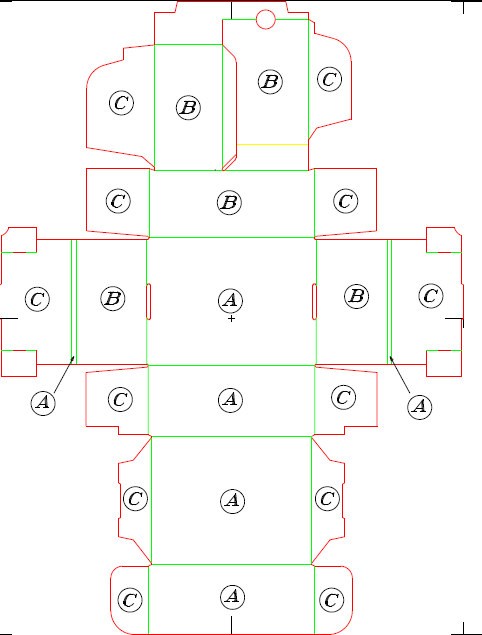
Illus. 1 Panel Classification — Panels A, B, and C Original
Panel A, B, C classification die-line for POS folding carton
Panel A — Major/primary panels containing legal copy or critical design elements. Panel B — Secondary panels (sides, interior). Panel C — Hidden panels (dust flaps). Referenced in §5.1 and §6.1.
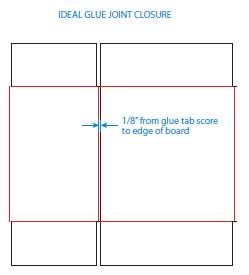
Illus. 2 Glue Joint Closure Original
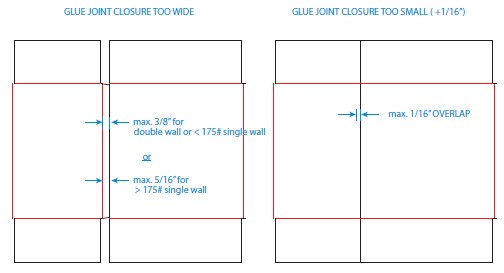
Ideal glue joint closure — 1/8 inch from glue tab score to board edge Glue joint closure too wide vs. too small comparison
Left: Ideal glue joint — 1/8" from glue tab score to edge of board. Right: Glue joint too wide (max 3/8" double wall or <175# single wall; max 5/16" for >175# single wall) vs. too small (max 1/16" overlap). Referenced in §7.3.
Illus. 3a Fishtailing Original
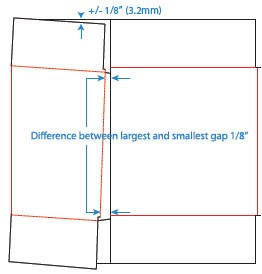
Fishtailing defect — gap width difference from score line ±1/8 inch (3.2mm)
Fishtailing occurs when slot cuts are angled, creating a gap width difference between the largest and smallest slot opening. Tolerance: ±1/8" (3.2 mm) from score line. Referenced in §7.3.
Illus. 3b Gap Resulting from Fishtailing Original
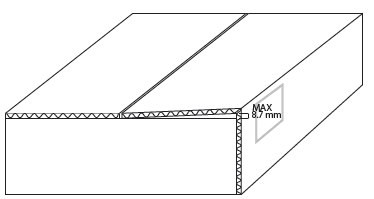
Gap resulting from fishtailing — maximum gap 8.7mm at assembled box corner
Gap at the assembled box corner resulting from fishtailed slot cuts. Maximum allowable gap: 8.7 mm. Referenced in §7.3.
Illus. 4 Slot Movement — Horizontal & Depth Original
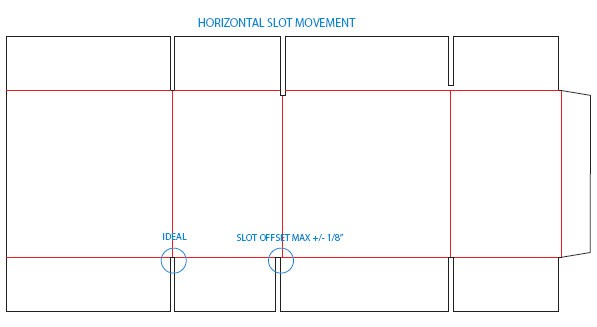
Horizontal slot movement — ideal vs slot offset max ±1/8 inch from score line Slot depth movement — ideal vs deep slot max +3/16 inch and shallow slot max -3/16 inch
Left — Horizontal Slot Movement: Slot offset from score line must not exceed ±1/8" (±3.2 mm). Right — Slot Depth Movement: Deep slot max +3/16"; shallow slot max −3/16" from score line. Referenced in §7.3.
Illus. 5 Zone A — Plastic Lid / Thermoformed Tray Original
Zone A — the entire front face product and graphic area of a plastic blister or thermoformed tray
Zone A encompasses any product or graphic area on the front face of the blister or thermoformed tray. Stricter defect criteria apply within Zone A per §11.3. Zone B is the surrounding border/flange area.
Illus. 6 Notching Example Original
Notching example — physical sample showing a notch defect at a folding carton board edge
Notching is a defect at the cut edge or corner of a board where material has been removed or torn, creating an indentation. Notching >1.5 mm on Panel A or B is a Minor defect per §5.5. Structural notches at stress points may elevate to Major.
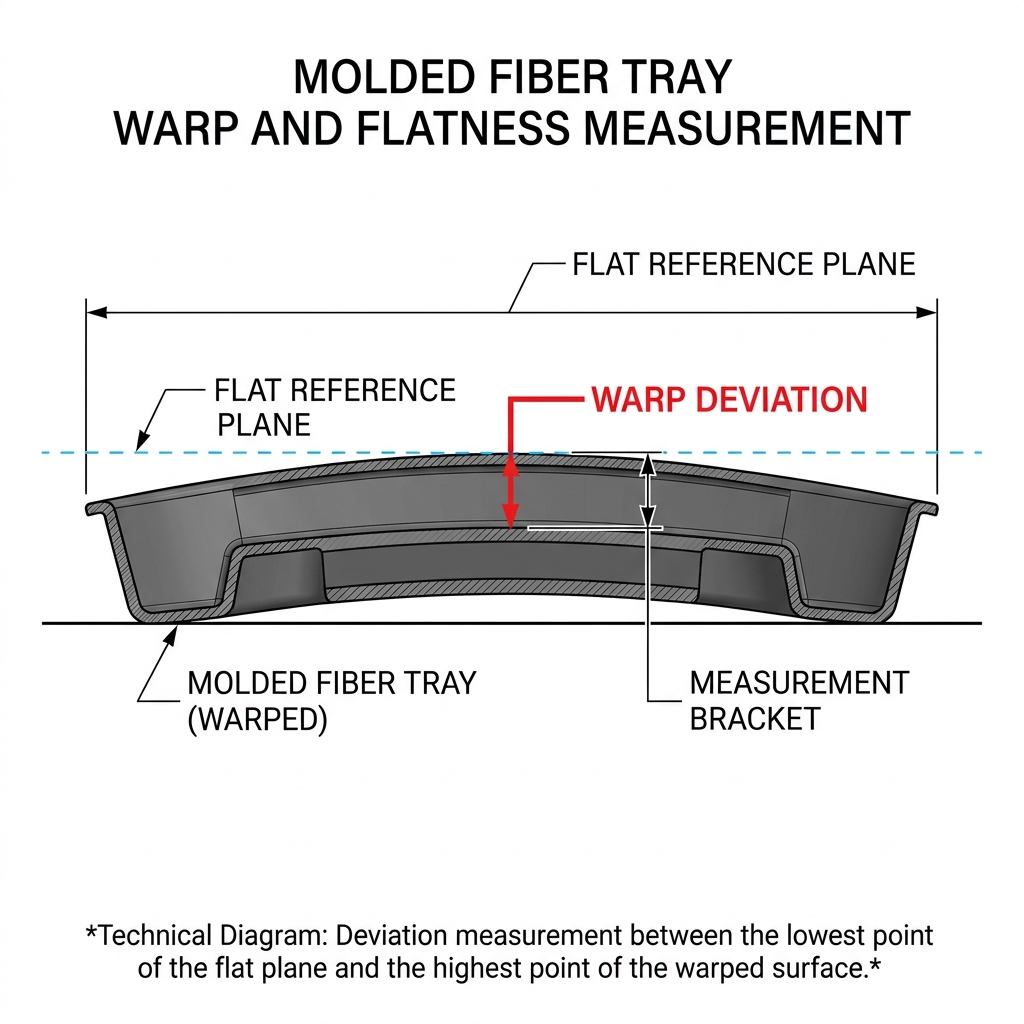
Illus. 7 Molded Fiber Warp / Flatness Measurement Reference AI Reference
Molded fiber tray warp and flatness measurement — deviation measured from flat reference plane
Warp deviation is measured as the maximum gap between the part surface and a flat reference plane placed across the span being measured. Dry Press: Maximum deviation ≤ 3.0 mm across any 100 mm span (§13.3.1). Wet Press: Maximum deviation ≤ 1.5 mm across any 100 mm span (§13.4.1). Test per TAPPI T 412 or equivalent.